
Elementary
Elementary
OUR GOAL FOR ELEMENTARY
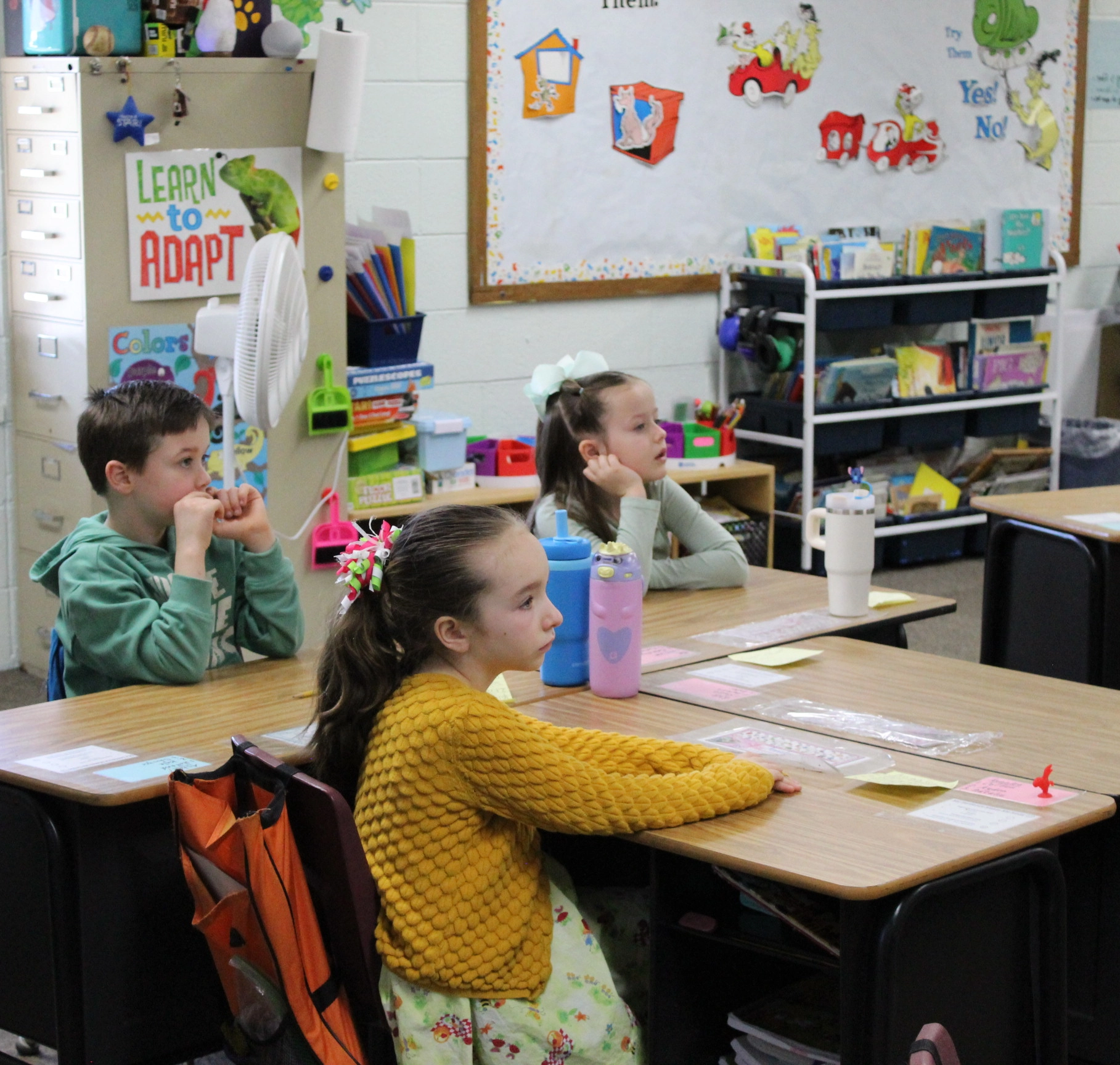
Our elementary program helps students develop essential foundational skills that set the stage for future success. As they progress, students learn to think critically, collaborate with others, and apply their knowledge to achieve meaningful goals—becoming lifelong learners along the way.
Elementary Academics
The kindergarten class operates 5 days a week from 8:05 a.m. to 3:10 p.m. This class provides children with an educational experience that will nurture not only their minds, but also their spirit.
Bible
The children learn that the Bible is God’s Word. They learn how to apply knowledge of the Bible to their daily lives. Each lesson emphasizes the personal need for a Savior and instills a desire in every child to know more about God. Students learn about the patriarchs of the faith through their daily lessons. There are weekly chapels.
Character Training
An essential part of early education is nurturing positive character traits, good conduct, and efficient work habits. Students learn to abide by policies and procedures, respect others, and uphold a strong work ethic.
Language Arts
Kindergarten students learn how to read by the use of phonics to master decoding and encoding of words. With a strong emphasis on phonemic awareness, instruction includes a multisensory approach to form an engaging and joyful mindset toward learning.
Penmanship
Kindergarten students learn how to properly write, as they are instructed on proper posture, paper position, pencil grip, and spacing. Students use these skills as they print letters, blends, and words. They also use these skills to properly write their first and last name.
Arithmetic
Kindergarten math nurtures number sense in young students. Students learn by using manipulatives and hands-on activities to develop problem-solving skills.
Social Studies
Students are introduced to cultures and geography from around the world. They learn that their Creator has made them unique and gives each responsibility wherever He has placed them.
Science
Students are introduced to God’s plan for the universe. Studies in habitats and other wonders of creation point them to God’s glory in all He creates.
Skills Development
Students practice activities to develop skills needed for physical, mental, social, and personal growth. They work on visual perception, motor coordination, social/personal skills, communication, and critical thinking skills.
Kindergarten Weekly Specials
Music, Art, Physical Education, Computer, Library
Bible
First grade students study a non-denominational catechism with 43 question-and-answer statements for students to memorize. Each Bible truth is introduced through illustrated and interactive Bible stories, activities, memory verses, and much more. Each Bible story begins by teaching students the foundational doctrines of the Christian faith.
Language ARts
First graders learn to read and develop a foundational knowledge of English grammar and mechanics.
Spelling
Spelling is a part of reading and phonics. Spelling words are practiced for five days followed by an assessment.
Penmanship
Recognizing the importance of honing fine motor skills, first-graders use and daily practice handwriting using Scripture, poetry, words, phrases, and sentences with simple writing instructions.
Penmanship
First graders use traits, grammar rules, and organization activity sheets to help with sentence development.
Reading
First graders work on developing fluency, reading strategies, comprehension, and more during reading circles. Stories are grade level appropriate in a variety of genres.
Arithmetic
First graders master addition and subtraction facts, telling time, counting money, analyzing data, learning parts of the calendar, and solving word problems. Students also practice skip counting, a skill later used in multiplication.
History
Students learn about historical events, world cultures, and our country.
Science
First graders have highly visual, interactive lessons in scientific concepts. They learn about life science, earth-space science, and physical science, while learning to defend the truth that God created all things and sustains their existence.
First Grade Weekly Specials
Music, Art, Physical Education, Computer, Library
Bible
Second grade Bible includes Christian worldview shaping through memorizing Bible verses, singing, praying, and learning Bible lessons. Beginning Bible study skills are also explored.
Language Arts
Second grade English fosters an appreciation of language as a gift from God. Students develop the correct use of grammar, begin learning the writing process, and develop reference skills.
Spelling
Second grade spelling emphasizes word sorting, word study, proofreading, dictionary skills, and writing application. The students study grade-appropriate words and enjoy hands-on review activities.
Penmanship
Second graders polish their manuscript writing habits and learn cursive writing. The writing habits learned in second grade will greatly influence their writing skills throughout their lives.
Reading
Second grade reading uses the phonics foundation to polish reading skills. Decoding, expression, and comprehension skills are developed. Students learn to read God’s Word and other literature.
Arithmetic
Arithmetic emphasizes addition and subtraction basic facts along with regrouping. The concepts of multiplication and division are also introduced. Number “sense” is emphasized by studying place value and problem solving. Manipulatives and review games help to make learning fun.
History
Throughout this course, second grade students develop an interest in history, geography, citizenship, economics, and culture. This course equips the student to discern connections between events and organize information in chronological order.
Science
Second grade science develops a knowledge of God through His creation. Life cycles, fossils, conservation, and earth science are just a few of the concepts studied. The scientific process is studied in depth and used in activities and hands-on experiments.
Second Grade Weekly Specials
Music, Art, Physical Education, Computer , Library
Bible
The goal of the Bible curriculum in the third grade is to engage students in their own Christian growth. Bible time is used to enrich students’ understanding of the Bible and how it applies to their everyday life. This time consists of singing, a Bible story or application story, discussion, and a review page.
Language Arts
The third grade language instruction fosters an appreciation of language as a gift from God that equips humans uniquely among the created order. Students are taught English and grammar skills, and learn the writing process.
Spelling
The spelling curriculum is designed to teach spelling patterns and strategies for application. Lessons include word sorting (by letter patterns), word study, proofreading, dictionary skills, and writing application activities.
Penmanship
Proper technique and formation of cursive penmanship is taught and reinforced in the third grade. Everything in the third grade is written in cursive.
Reading
Third grade reading curriculum uses several different reading books (readers) to increase comprehension, fluency, and vocabulary while promoting good character through age-appropriate stories.
Arithmetic
The arithmetic curriculum includes review of addition and subtraction, mastery of multiplication and division facts, fractions, graphing, geometry, and converting measurements. Every lesson not only focuses on a key concept, but it also reviews previous lessons.
History
The third grade history curriculum emphasizes how God worked in our country from its formation through the Civil War.
Science
Third grade science curriculum endeavors to establish a biblical worldview upon which all scientific discoveries are based. It emphasizes a knowledge of God and His creation, and man’s role in stewarding that creation.
Third Grade Weekly Specials
Music, Art, STEM (Science, Technology, Engineering, Math), Physical Education, Computer, Library
Bible
Fourth grade Bible instruction focuses on the Old Testament. Bible is an academic subject that includes the memory of Bible verses, but the goal is to teach the students to have a Biblical Worldview. Bible class time strives to instill a desire in students to know more about God, and promote understanding and application of God’s word.
Language Arts
The study of English in fourth grade fosters an appreciation of language as a gift from God. English class develops the correct use of English grammar in written and oral communication. The curriculum includes the identification of the eight parts of speech, sentence types, diagrams, the writing process, and reference skills. Students complete eight writing projects that include, personal narrative, friendly letter with instructions, compare-contrast essay, book review, tall tale, research report, business letter, and poetry.
Spelling
Spelling instruction equips the student to apply spelling skills in order to produce accurate, God-honoring written communication. The weekly list of lessons includes word sorting according to phonetic rules, word study, proofreading, dictionary skills, and writing application activities.
Penmanship
Fourth graders continue perfecting their cursive writing skills. Correct letter formations are introduced/reinforced at the beginning of the year. Students are expected to demonstrate correct formation, spacing, letter size, slant, proportion, as well as overall neatness and good appearance.
Reading
The fourth grade reading program teaches students about different types of genre, author’s craft, story structure, and vocabulary while using well-known literature. Students also write and illustrate their own poetry and stories.
Arithmetic
Fourth graders should have complete mastery of addition and subtraction upon entering fourth grade. The fourth graders are expected to know the 0–12 multiplication tables as this knowledge is necessary to progress onto more complex processes such as long division, larger multiplication problems, measurement equations, factoring, fractions, algebra, beginning geometry, and multiple-step story problems.
History
Fourth grade history covers the founding of our great nation, The Revolutionary War, The Civil War, Rebuilding, The Wild West, Growing Cities, The Gilded Age, The Spanish-American War, Progressivism, WWI, Black Tuesday, The Great Depression, and WWII.
Science
The fourth grade science curriculum includes ten units of study: Living Things, Insects and Spiders, Plants, Forces and Machines, Electricity and Magnetism, Light, The Moon, Water and Oceans, Weathering and Erosion, and The Earth’s Resources, with supplemental units of study in health: Digestion, Bones, and Muscles.
Fourth Grade Weekly Specials
Music, Art, STEM (Science, Technology, Engineering, Math), Physical Education, Computer, Library, Noteworthy Chorale (optional)
Bible
In fifth grade, students are encouraged to grow in grace and knowledge by memorizing a weekly Bible verse. Throughout the year, students are taught many lessons in which they learn about God’s judgment and grace. This helps to build godly character and obedience with a focus on evangelism and missions. Lessons are taught using accounts from the Bible as well as stories about many heroes of the faith and missionaries. Students also attend a weekly chapel service.
Language Arts
Fifth grade English alternates between grammar lessons and writing units. Grammar lessons review and expand on previously learned concepts through daily guided lessons and independent practice. Writing units reinforce the writing steps as students apply their grammar skills when completing writing assignments such as sense poems, book reports, and personal narratives.
Spelling
Spelling challenges each student to use written language to communicate effectively. Students learn spelling patterns and strategies for application. Students will be equipped to use effective proofreading and dictionary skills. Finally, students will incorporate meaningful writing experiences with their spelling consciousness.
Reading
Fifth graders continue to develop the reading skills of fluency, accuracy, and expression through daily reading assignments. They also expand their word knowledge through weekly vocabulary assignments and activities. Students will also read novels throughout the year and participate in book report activities.
Arithmetic
Students learn about and develop an understanding of such topics as whole numbers, fractions, decimals, graphs, and algebraic equations through daily lessons, review games, speed drills, in-class/small work groups.
History
American History is the focus of study in fifth grade. Beginning with a study on America’s First People, students learn about the founding of America, the establishment of our government, and how America has grown and changed throughout time. Students will study about all the major wars, including the Revolutionary War, Civil War, WWI, and WWII. Different time periods, including the Colonial Era, the Gilded Age, and the Roaring ’20s, are also studied in addition to a variety of geography skills.
Science
Science lessons are taught based on a Christian worldview foundation, in which students learn that God is the Creator of everything, that people are important to God, and people were put on earth by God to have dominion and authority over God’s creation. Students are encouraged to explore God’s world through a variety of methods, including reading, videos, hands-on activities, and experiments. Among the many topics covered in fifth grade science are fossils and dinosaurs, biomes, weather, and minerals and rocks.
Fifth Grade Weekly Specials
Music, Art, STEM (Science, Technology, Engineering, Math), Physical Education, Computer, Library, Noteworthy Chorale (optional), Band (optional)
.png)