
High School
High School
OUR GOAL FOR HIGH SCHOOL
Rigorous courses that encourage critical-thinking, analysis, and real world application so that students will be well-prepared for life.
High School Academic Content
The Triumph of Christ (9)
(.5 credit)
This course examines the birth and growth of the early church following the ascension of Jesus and the coming of the Holy Spirit at Pentecost. Students will study the New Testament books from Acts through Revelation to gain an understanding of the church’s origins, expansion, and future. The course highlights how the Gospel spread beyond Jewish communities to reach the Gentile world and emphasizes the development of Christian living through the teachings found in the Epistles. Students will also explore the future hope of the church, gaining a deeper appreciation for its mission, perseverance, and role in God’s ongoing plan.
Bible Doctrines (10)
(.5 credit)
This course introduces students to foundational concepts in theology while encouraging thoughtful engagement with key ideas through discussion and reflection. Students explore important and enduring theological questions, develop familiarity with essential theological vocabulary, and engage with the perspectives of various theologians. Emphasis is placed on building critical thinking skills through dialogue and written analysis, helping students deepen their understanding of faith, belief, and theological inquiry.
Discipleship & Spiritual Formation (11-12 Alternating Years)
Semester 1 (.25 credit)
This course guides students in developing a personal rhythm of spiritual discipline as they grow in their faith. Through an exploration of spiritual practices, students learn how to apply disciplines such as prayer and devotion in daily life while deepening their relationship with God. The course introduces the meaning of discipleship and encourages students to live it out authentically, emphasizing Christian formation as a process of becoming more like Jesus Christ for the benefit of others and the glory of God.
Cultural Engagement & Missions (11-12 Alternating Years)
Semester 2 (.25 credit)
This course builds on the principles of Discipleship and Christian Formation by focusing on how to live out and share one’s faith in fulfillment of the Great Commission. Students explore practical ways to communicate the message of the Gospel in a world in need, while considering both effective and ineffective approaches to outreach. Emphasis is placed on developing a clear understanding of culturally relevant mission work, equipping students to share their faith confidently, and preparing them to serve as ambassadors of the Gospel in any vocation.
Apologetics (11-12 Alternating Years)
(.5 credit)
This course introduces students to Christian apologetics as a branch of theology, focusing on developing a rational foundation for belief in the Christian faith. Students engage with key questions about truth and Scripture while learning how to thoughtfully defend their beliefs. The course also explores competing worldviews, helping students recognize their strengths and weaknesses, and fosters critical thinking skills as students examine and respond to objections to Christianity.
Listed below are the mathematics courses required for the College Prep diploma.
Algebra I
(1 Credit) Required: Alg. 1 or Adv. Alg. 1, Prerequisite: 8th grade math
During this course, students will write and solve multistep equations, graph linear equations, write equations of parallel and perpendicular lines, write and solve various inequalities, solve systems of equations by graphing and substitution, solve equations with polynomial expressions, and graph quadratic functions. Heavy emphasis is placed on slope and graphing.
Advanced Algebra 1
(1 Credit) Required: Alg. 1 or Adv. Alg. 1, Prerequisite: Teacher recommendation
The study of Algebra 1 is foundational to all higher math. This course proceeds at a more rapid pace than Algebra 1, thus covering some special topics at the end, such as graphing radical and exponential functions. Students will learn to evaluate numerical and algebraic expressions, including radicals. Graphs of lines and developing equations of lines algebraically will be studied in detail. Polynomials and factoring will be studied extensively, and parabolas will be introduced with other non-linear graphs. The course concludes with statistics and probability, time permitting.
Geometry
(1 Credit) Required: Geo. or Adv. Geo., Prerequisite: Algebra 1
During this course, students will learn relationships between angles. Proofs are introduced, including inductive reasoning and conjecture. Graphing lines and distance between points will be reviewed. Triangle and quadrilateral classification and application of theorems are studied in detail, including the use of algebraic expressions. (The use of algebra will continue throughout.) Students will understand ratios and proportions, as well as some trigonometry late in the course. Coordinate geometry will be used in the sections.
Advanced Geometry
(1 Credit) Required: Geo. or Adv. Geo., Prerequisite: Adv. Algebra 1-C or better or teacher recommendation
Euclidian Geometry is taught with heavy emphasis on coordinate Geometry. The course is taught at a faster pace than Geometry, enabling students to become better prepared for advanced courses like Trigonometry or Pre-calculus. Formal proof is introduced early and continues throughout. Relationships in triangles, quadrilaterals, polygons and circles are studied as well as right triangle trigonometry. The course concludes with a thorough study of area, surface area, and volume.
Algebra II (11)
(1 Credit) Elective. Prerequisites: Algebra 1 & Geometry
Algebra 2 continues the study of Algebra I. Linear equations and inequalities, including the use of matrices, will be studied. All types of functions and their graphs will be considered, including transformations. Radicals, logarithms, and complex numbers are included. Students learn to use graphing calculators.
*Students choose which math classes to take their senior year from the following classes.
Statistics (12)
(1 Credit) Prerequisites: Algebra 1 & Geometry
The study of Statistics begins with probability and various types of data descriptions. Binomial distributions will be covered, and the normal distribution will be studied extensively. Confidence intervals will be considered, followed by hypothesis testing. The course concludes with correlation regression, and, time permitting, ANOVA testing and chi square tests.
Pre-calculus (12)
(1 Credit) Prerequisites: Algebra 1, Geometry & Algebra 2 – C or better
The study of pre-calculus begins with an in-depth study of functions including linear, polynomial, rational, exponential, and logarithmic. The conics are reviewed. Systems of equations are studied, including the use of matrices. Emphasis is placed on solving all types of equations, including the use of a graphing calculator. Limits and derivatives are introduced.
Listed below are the mathematics courses required for the regular diploma.
Intermediate Math
(1 credit)
Intermediate Math is a foundational course designed to review and strengthen the essential skills needed for success in high school mathematics and everyday problem-solving. The course emphasizes building proficiency and confidence through practice with core mathematical concepts.
Students will develop and refine their understanding of operations with whole numbers, fractions, decimals, and signed numbers. Additional topics include percents and percentages, measurement, area, perimeter, volume, probability, graphing, and an introduction to basic statistics.
Through consistent practice and application, this course aims to equip students with the skills necessary for future math classes while also fostering practical mathematical understanding for real-life situations.
Essentials of Geometry
(1 credit)
Essentials of Geometry is a course designed to guide students through the foundational concepts of geometry. Throughout the course, students explore concepts such as reasoning and proof, principles of triangles and quadrilaterals, and area, perimeter, and volume.
Students will develop proficiency in essential geometric skills and learn how these concepts connect to real-world situations. Each unit emphasizes practical applications, helping students understand how geometry is used to model and solve everyday problems.
Essentials of Algebra
(1 credit)
Essentials of Algebra is a course designed to guide students through the foundational concepts of algebra. Throughout the course, students explore key topics including solving linear equations, working with systems of linear equations, writing and interpreting inequalities, analyzing polynomial expressions, and applying data analysis techniques.
Students will develop proficiency in essential algebraic skills and learn how these concepts connect to real-world situations. Each unit emphasizes practical applications, helping students understand how algebra is used to model and solve everyday problems.
English 9
(1 credit) Required
Students will build skills in grammar, writing, and literature. Emphasis will be placed on communicating effectively though writing, and successfully comprehending and analyzing literature. Students will read and write in multiple genres, commit poetry to memory, and continue to develop their vocabulary and grammatical skills.
English 10
(1 credit) Required
This course includes a study of grammar focusing on parts of speech, sentences, and usage. It includes sentence analysis and development of writing skills through essay and research assignments. Development of vocabulary and memorization of poetry are included. Analysis of literature, including short stories, poetry, prose, and a Shakespeare play, is also developed in this course. Literary analysis will focus on character, theme, setting, and conflict. Interpretation and communication skills will be strengthened through application of critical evaluation and group interpretation.
Literature and Composition (11 and 12)
Required (1 credit required for each year: Brit. Lit. & Comp. or Advanced Lit. & Comp.)
This class is a chronological survey of the origins and development of English Literature as well as a course designed to help prepare students for college-level writing and research. The curriculum consists of analytical reading, critical writing skills, multiple essay genres, vocabulary enrichment, in-class writings, projects, and research papers. Throughout the course, students will be expected to read, analyze, and respond to a variety of texts.
Advanced Literature and Composition (11 and 12)
Required (1 credit required for each year: Brit. Lit. & Comp. or Advanced Lit. & Comp.)
This class is a chronological survey of the origins and development of English Literature as well as a course designed to help prepare students for college-level writing and research. The curriculum consists of analytical reading, critical writing skills, multiple essay genres, vocabulary enrichment, in-class writings, projects, and research papers. Greater emphasis is placed on Shakespearean texts as well as more independent analysis than the British Literature and Composition class. The class is conducted at a more rapid pace, and writing assignments are generally more demanding.
Speech
(.5 credit) Required
Students in this class learn and practice developing the skills necessary for effective verbal and non-verbal communication. Students have many opportunities to improve their public speaking and presentation skills both in person and through the use of technology. Students develop an awareness of the basics of rhetoric and learn to analyze the rhetorical situation as well as to recognize common propaganda techniques. Students will work to develop excellent listening and communication skills that, ultimately, will help them be better equipped to share the Gospel of Christ.
Physical Science (9)
(1 credit) Required, Prerequisite: Pre-Algebra
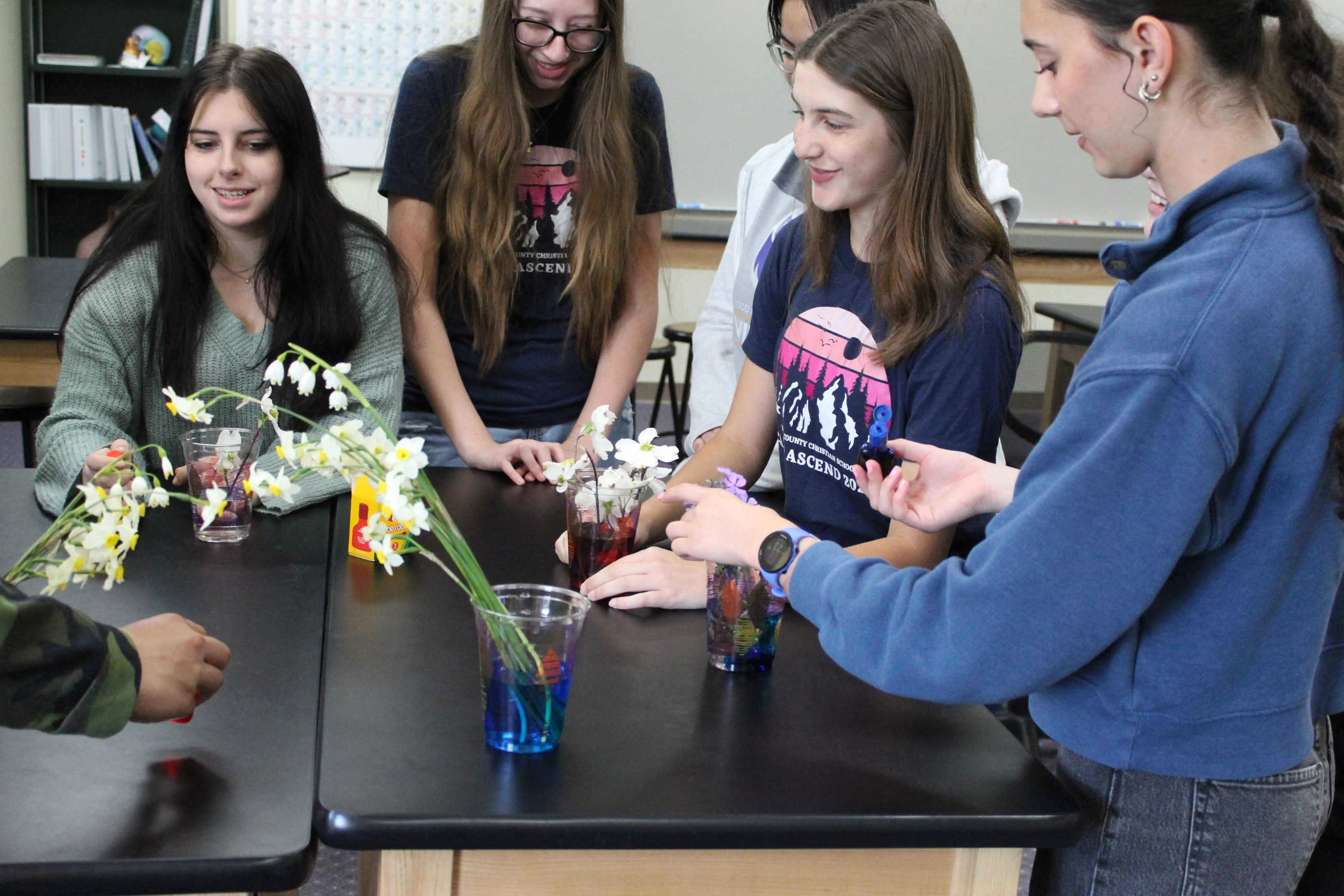
This is a basic, but in-depth, science class that covers principles in chemistry and physics. Foundational concepts will be taught that can be used in later science classes. Chemistry concepts covered include building of the Periodic Table, structure of the atom, and bonding. Physics concepts include a history of science and application of it to the Creation Mandate, classifications and changes in matter, dimensional analysis, kinematics, dynamics, energy, work, simple machines, and electricity. This is a lab-based class with hands-on activities presented for each unit of study.
Biology (10)
(1 credit) Required
This course is a study of cells, genetics, and the plant and animal kingdom. It includes an overview of the systems of the human body. There are numerous science labs during the year, including dissection of an eyeball and a microscope lab.
Chemistry (11)
(1 credit) Required: Prerequisite: Algebra I
The Chemistry course begins with the scientific method and a discussion of the history of chemistry. The classification and states of matter and the elements are discussed in detail. Atomic structure, chemical bonding, and nomenclature are covered extensively. Chemical reactions, acids/bases and redox reactions, and stoichiometry are studied and applied in hands-on labs.
Physics (11-12)
(1 credit) Elective, Prerequisite: Algebra 2
Velocity, speed, and acceleration will be worked with extensively, along with Newton’s Laws, force, motion momentum and the concepts of work, energy and gravitation. Wave theory will be introduced that includes key concepts of sound. Light & optics are discussed. Magnetism and electricity are also studied. This is a lab-based class with hands-on activities presented for each unit of study.
Anatomy (11-12)
(.5 credit) Elective, Prerequisite: Biology – B or better
Students will investigate the systems of the human body in depth. Special dissection of the animal specimens are included as well as a study of the Drosophila fly and genetics.
World History (9)
(1 credit) Required
World History builds upon previous courses by instructing students in events from the early days of God’s creation to the nation building of the 19th century. This course focuses on the study of numerous nation-states from Great Britain, France, and Germany to the civilizations of the Middle East, India, and China. Students use their knowledge to decipher, appreciate, and appraise the cultural differences of various civilizations.
US History (10)
(1 credit) Required
US History builds upon previous United States history courses in discussing people, events, and ideas that originated at the foundation of the United States. This class begins in colonial times and works through the Revolutionary War, the creation of the republic, and the course of the country through the Civil War. With God at its center, this course develops students’ abilities to apply, synthesize, and evaluate information on people, places, and turning points in the history of the United States.
Contemporary History (11)
(1 credit) Required
The study of this course focuses on the relevance of the last century moving into our current timeline. The focus is on United States history, but the class also covers many international events such as World War I, World War II, and the Cold War. The goal of this course is for students to develop a new and better appreciation for the recent history of the United States in the world. It helps advance their abilities in describing, evaluating, and justifying recent events.
American Government (12)
(.5 credit) Required
Through this course, students will examine a Christian’s relationship to government, early governmental foundations and founders, the Constitution, political parties, the branches of government, and foreign policy.
Economics (12)
(.5 credit) Required
This class explores basic economic principles, current economic issues, and the concept of choice and consequence on both personal and global scales. Basic concepts such as utility, opportunity benefit and cost, subjective value, free-market capitalism and other economic models, as well as a biblical perspective of personal finance will be studied.
Spanish I
(1 credit) Required
The goal of Spanish I is to introduce the student to the Spanish language and culture through development of basic grammar and vocabulary skills, utilizing projects, dialogue, and exercises.
Students will express themselves through written and spoken language to demonstrate a knowledge of sentence structure, vocabulary correctly used in cultural context, and memorization of scripture. Speaking Spanish in class is encouraged, and writing in the language is required to increase ability in use and comprehension of both the written and spoken word.
Spanish II
(1 credit) Required, Prerequisite: Spanish I
This class builds on the foundation laid in Spanish I in order to further develop language use and cultural understanding. Basic verb tense and use, along with vocabulary and sentence structure will be expanded by the addition of more advanced grammar and vocabulary skills. Utilizing skits, projects, and videos, students will develop a deeper understanding of Spanish language and culture. Speaking the Spanish language in class is encouraged and writing Spanish is required to increase ability to use and comprehension of both the written and spoken word.
Modern Media & Publishing I, II, III, & IV
(.5 credit each)
Students will learn the elements of journalism and writing in the digital age. Students will conduct interviews, produce accurate reporting, and use web-based platforms like WordPress and Substack to publish written content. The students will collaborate with the yearbook class to provide written articles and will be given opportunities to have their work published in both print and digital formats. The class will also discuss media ethics and how a journalist’s commitment to truth is based on Biblical principles.
Digital & Media Design I, II, III, & IV
(.5 credit each)
A creative, project‑based course where students learn the fundamentals of visual communication through hands‑on digital design work. Using tools such as Canva, Adobe Creative Suite, and Microsoft 365, students create logos, promotional graphics, posters, and social media content while developing skills in layout, typography, color theory, and visual hierarchy. The course emphasizes ethical media use, audience awareness, and the influence of digital design in modern culture. Students also explore how to communicate messages effectively through a Christian worldview, using design to inform, inspire, and positively impact their communities.
21st Century Technology Skills
(.5 credit)
This course equips students with an understanding of how technology shapes the world around them and prepares them to engage with it ethically, productively, and creatively. Students will explore real-world applications of technology, such as AI, data, digital communication, cybersecurity, and design thinking, while reflecting on their role as responsible digital citizens and future innovators. The course assumes students are already proficient in Microsoft 365 and instead focuses on how these tools support collaboration, problem-solving, and productivity in various industries. Rooted in a biblical worldview, students will be challenged to evaluate emerging technologies, seek wisdom in their use, and apply their skills to serve others and glorify God in an increasingly digital world.
Media Productions
(.5 credit each)
Students will learn to use a variety of presentation and video‑production tools to create high‑quality graphics and visual content for programs, chapels, advertising, and school social media. Through real‑world, creative projects, they will gain valuable experience in digital communication—skills that are highly relevant for today’s technology‑driven society and future résumés. This course gives students the opportunity to develop their creative strengths while contributing meaningful work that enhances the culture, communication, and overall experience at WCCS. By applying professional tools and modern media practices, students grow as confident creators who can impact their community in positive and purposeful ways.
(Note: Not all courses are offered every year.)
3D Printing
(.5 credit)
Students will learn to design 3D models using Tinkercad. They will learn to use Ultimaker Cura, a 3D printing slicer software, which converts 3D models into G-code, the language 3D printers understand. They will learn how to change settings to get an optimal 3D print. They will learn how to set up the 3D printer, print 3D models, and troubleshoot problems with their 3D prints.
Advanced Art
(.5 credit) Pre-requisite: General Art
Students will discover the connections between drawing, other art disciplines, studying past and current events, God, and His creation for inspiration to create art. Students will gain knowledge of the visual arts, theory, and practice through experiences in different visual arts media areas.
Anatomy
(.5 credit) Pre-requisite: Biology
Students will investigate the systems of the human body in depth. Anatomy is the study of body structures and physiology is how those structures work together. During this class, students will gain a mastery of the body systems individually as well as how God designed them all to work in unison. This class uses case studies and a 3B Smart Anatomy human torso that allows students to utilize resources, including technology, to find, analyze and evaluate information. The anatomy class pursues a more in-depth study of several of the body systems. Included in the year’s study are dissections of the heart and eyeball, experiments with fruit flies and a major field trip. Costs would be the admission for the selected field trip.
Assistants
(.5 credit)
Students can serve as teacher, office, or maintenance assistants. An application process is required.
Band
(.5 credit)
This is a performance-based class. Students must have played their instrument for at least one year and complete an audition. Students will learn a variety of music styles throughout the year. The band will participate in the WVCEA Fine Arts competition in the spring as well as other performance opportunities such as the Christmas program and chapel.
Bible Quizzing
(.5 credit)
This class studies a specific New Testament portion of scripture on a 9-year rotating cycle. For each school year, concentration is placed on a specific text to learn and know thoroughly through drills and memorization. Bible Quizzing is a “jump-quizzing” double-elimination competition measuring Bible knowledge and speed of recall. WCCS participates in competitions in various states to improve in these areas.
Choir
(.5 credit)
This course is a performance-based class. Students spend much of their time preparing for performances. Students will perform throughout the school year. (Christmas program, Graduation, Fine Arts, and more). Students will sing many different styles of music while working to improve their vocal techniques (diction, range of voice, breathing, etc.)
Christianity and the Humanities
(.5 credit – juniors & seniors only)
Students will be involved in a discussion-based class that explores the overall concepts of the humanities, as well as how Christians have impacted the world in a variety of fields, including art, science, literature, and music.
Current Events
(.5 credit)
Engaging with the world requires knowledge of modern-day times and occurrences. Current Events explores local, national, and international happenings. Understanding how the world functions is a large part of being an informed citizen and an educated Christian.
Film Studies
(.5 credit)
The Film Studies elective is designed to teach students the fundamentals of film theory. Students will learn the basics of several cinematic concepts to analyze film as a visual art form and a culturally significant mode of communication. In addition to class lectures and discussion, students will watch a variety of films and film clips in class. The class will focus on one specific topic every four years. The topics include film history, film genres, world cinema, and Judeo-Christian concepts in film.
Food Service Prep
(.5 credit)
This course is a hands-on course designed to equip students with essential skills in maintaining cleanliness in food service areas, preparing meals for large groups, and effectively serving food. Students will gain practical experience in adhering to industry standards for hygiene and food safety. A food handler's license is required to enroll in this course, ensuring all participants are well-versed in safe food handling practices. This course is ideal for those interested in pursuing careers in the food service industry. (Acceptance into class is based on interview with the Cafeteria Manager. Limited availability.)
General Art
(.5 credit)
This class will provide a variety of art skills by using a variety of art mediums and methods. From clay to canvas, students will have hands-on opportunities to express their creativity. (for grades 9 & 10)
Graphic Design
(.5 credit)
In Graphic Design 1 students will learn to apply the elements and principles of art and design through their own works. Students will also explore the graphic design process while working on projects. Computers are used as a tool for creating work. Some projects will be created on the computer; others will be created by hand.
Home Arts
(.5 credit)
Students will learn basic life skills such as: cooking, sewing, home maintenance and basic repairs, meal planning and budgeting, car maintenance, childcare, etc. Evaluation will be through projects, written assignments, and class discussion. This class will teach students to be committed to lifelong learning and personal excellence, to have a positive work ethic, and to give their best to glorify God.
Opening Minds Through Art
(.5 credit)
Opening Minds through Art (OMA) is an award-winning, evidence-based, intergenerational art-making program for people living with dementia. It was developed at Scripps Gerontology Center, an Ohio Center of Excellence at Miami University, in 2007. People living with dementia (artists) are paired with WCCS students who are trained to rely on imagination instead of memory and focus on remaining strengths instead of lost skills. OMA enables people living with dementia to assume new roles as artists and teachers and leave a legacy of beautiful artwork. Students will travel to a local nursing home to work with residents. (juniors & seniors only)
Physics
(.5 credit)
Velocity, speed, and acceleration will be worked with extensively, along with Newton’s Laws, force, motion, momentum and the concepts of work, energy, and gravitation. Wave theory will be introduced that includes key concepts of sound. Light & optics are discussed. Magnetism and electricity are also studied. This is a lab-based class with hands-on activities presented for each unit of study. Pre-requisite: Chemistry
Robotics
(.5 credit)
Students utilize VEX Robotics kits and a combination of Block-based and C++ software to design and program. Students are introduced to basic programming as well as problem-solving strategies. Students work in teams to design, build, program, test and document their progress. Topics include motor control, gear ratios, torque, friction, sensors, timing, program loops, logic gates, decision-making, timing sequences and propulsion systems.
STEM
(.5 credit)
The Engineering Design Process and Scientific Method are reviewed. Lessons focus on problem-solving and teamwork. Students are introduced to a variety of STEM careers. Students will learn to work with Tinkercad or Onshape to design 3-D objects. They will then learn to print the objects on a 3-D printer. They will learn electronics using Arduino IDE. They will use Code.org to create apps with Circuit Playground, Develop Websites, and Interactive Animations and Games. Other topics that may be explored include space, astronomy, boats, bridges, earthquakes, drones, airplanes, forces and motion, and rockets.
Strength & Conditioning
(.5 credit)
This course is designed to improve students’ overall physical fitness through structured strength training, conditioning, and athletic development. Emphasis will be placed on proper technique, injury prevention, goal setting, and developing lifelong healthy habits. Students will also learn discipline, teamwork, and personal responsibility while honoring Christian values in effort and attitude.
Sound Crew
(.5 credit)
Sound crew will guide students on how to set up and manage events in many different capacities. Students will learn the different types of equipment, how they are used, and how they are to be properly maintained and stored. The crew will also learn to work as a team and solve problems together quickly and correctly. Students will be required to be present at chapel services and other events to ensure a quality sound experience for the event.
Technology Assistant
(.5 credit)
Students will work on school technology equipment to troubleshoot problems and resolve issues reported. These experiences will give students experience in networking, equipment repair, software, and internet issues.
Worship Leadership
(.5 credit)
Through participation in Worship Team, students will be challenged to develop spiritually, vocally, and/or instrumentally and to use their gifts to lead and encourage worship in the school and community. In addition to leading weekly chapel worship, students may be asked to lead music for a variety of school and community events.
Yearbook
(.5 credit)
Learn skills in writing, photography, and design while preparing the school’s yearbook. Take on leadership roles to improve organizational skills, teamwork, editing, and meeting deadlines.
Health (9-10)
(1 credit) Required
This class will provide guidance and emphasis on caring for God’s temple, our body. The students will be given hands-on activities, projects, field trips, and guest speakers to encourage a healthier lifestyle. Throughout the school year, topics will include: body basics system, mental and emotional health, nutrition, exercise, safety, and CPR training, as well as the dangers of drugs, alcohol, and tobacco.
College & Career Readiness (11)
(.5 credit) Required
This class is designed to guide and encourage the students to consider the different pathways available after high school. The students will be given the practice ACT & SAT tests with guidance on college and technical school entrance exams. Financial Literacy for banking, savings, payment types, credit cards, credit scores, financing, and taxes with assessments after each topic will be covered. Seminars on communication skills, resume formatting, and the interview process will also be covered. A variety of guest speakers will be giving seminars on the following topics: colleges, careers, internet safety, and armed forces and the military. The students will travel to the local colleges for campus tours.
Physical Education (9-10)
(1 credit) Required
In this course, the student will learn mental, social and physical well-being. The student will also be introduced to principles of exercise, fitness, and movement skills. This will be accomplished through team and individual games and fitness training to promote mental, social, and physical well-being.
.png)